|
Overview
Between 1930 and 1954, global events transformed Alaska from a wilderness frontier into both a ‘hot’ and ‘cold’ wartime front, reestablishing Alaska’s role as a “bridge to the Pacific.” When the Stock Market crashed in 1929, plunging the nation into the worst economic crisis in its history, Alaska’s remoteness could not keep the territory from being directly impacted by the Great Depression. Two ways in which the federal government introduced New Deal policies to Alaska was the Indian Reorganization Act of 1936 and the creation of the Matanuska Colony in 1934.
After Imperial Japan attacked Pearl Harbor on December 7, 1941, Alaska’s Aleutian Islands were not only viewed as “stepping stones to Asia,” but stepping stones from Asia. Responding to the eastern threat from Japan, the U.S. armed forces became a major presence in the North. The U.S. Army built several airbases ranging from Metlakatla in the southeast to Cold Bay in the southwest. U.S. Army engineers began construction of the Alcan Highway in 1942. And even before the bombing of Pearl Harbor, Alaska was part of the Lend-Lease program, serving as the final leg of a northern air route that ferried war supplies between Fairbanks and Central Russia. Alaska lying strategically close to Asia, was inevitably drawn into World War II, with the Aleutian Islands as the combat zone.
Linking Alaska to the world also changed lives on the home front. Hundreds of Alaskans volunteered to fight the war abroad, leaving Alaska for the first time. Others safeguarded Alaska’s vast coastline and territory against invasion. Aleuts were evacuated from their homes on the Aleutian Islands for their safety, but interned in southeast Alaska against their will and civil liberties. The war revolutionized transportation and communications systems in Alaska and expanded American cultural influences in unforeseen directions and dimensions.
World War II completely, profoundly, and permanently changed Alaska. The population grew from about 60,000 in 1940 to more than 100,000 at the end of the war. The United States government spent about $3 billion in the territory over the course of the war. Airfields, communication installations, and roads were built in various parts of Alaska to facilitate military movement. Wages and rent were high, and every line of business seemed to profit. Instead of a peacetime bust, the Cold War inspired a new wave of federal spending for infrastructure and communication improvements. Historian Stephen Haycox notes, “Alaska would never return to the quiet and isolated days of the prewar period.” Today, many Alaskans who lived through such historic times consider those years as a confluence between the “old rural lifestyle and modern American culture.”
|
 |
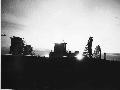 |
| Port Hediden became part of the defense line known as White Alice. |
|
|
|
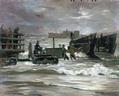 |
| Landing painting by William F. Draper |
|
|
|
|